
You already know how to manage an efficient crew on site - but what about managing your resource cost on the job? Reducing material waste on epoxy installation and concrete polishing projects directly safeguards your job profitability. Even a 10% over-order on liquid resin or a couple of prematurely cured pails can cost you hundreds of dollars in investment, let alone the time and labor waste.
XPS' experience indicates that precise inventory control and accurate surface measurement form the bedrock of sustainable business growth. Follow these steps to stop leaving unnecessary profits sitting on the slab.
Epoxy Resin Coverage Rate: Using Just What You Need
1. Dial In Coverage Epoxy Resin Coverage Rates With a Rate Calculator
Estimating material requirements off rough blueprints or eyeballing slab layouts leads directly to over-mixing and abandoned buckets. If your bids are built on guesswork, you're gambling with your profit margins. Double check that every calculation accounts for the actual site parameters long before you mix any resinous coating solutions.
To establish exact numbers when estimating epoxy resin for concrete floors, implement the following measurement protocol:
-
Measure Net Square Footage, Not Gross Footprint: Deduct drains, permanent machine pads, expansion joints, and structural columns before calculating total resin volume requirements.
-
Factor in Concrete Surface Profile (CSP): Manufacturers list standard coverage rates based on ideal, smooth substrate conditions (typically CSP 2–3). Depending on the surface profile and coating system, material consumption can increase by 15% to 30% or more.
- Don't use acid etching solutions, mechanical grinding isn't just more efficient, it's safer and more consistent, too.
- Don't use acid etching solutions, mechanical grinding isn't just more efficient, it's safer and more consistent, too.
-
Account for Slab Porosity: Older, dry, or unsealed concrete rapidly drinks up liquid primers and chemical densifiers.
- Perform a quick water-drop test across multiple zones of the slab; if water absorbs in under 30 seconds, budget for a heavier prime coat or a sacrificial sealer coat rather than soaking expensive pigmented build coats into the substrate.
- Perform a quick water-drop test across multiple zones of the slab; if water absorbs in under 30 seconds, budget for a heavier prime coat or a sacrificial sealer coat rather than soaking expensive pigmented build coats into the substrate.
- Verify Wet-Film Thickness (WFT): Relying strictly on visual estimation results in uneven mil thickness across the slab. Good practice means applicators should verify WFT gauges occasionally to confirm they are not laying down 25 mils on a 15-mil specification.
Utilizing a reliable epoxy floor coverage rate calculator helps eliminate visual guesswork, empowering your team to order precisely what is required. Published coverage figures for professional resinous systems serve as a baseline.
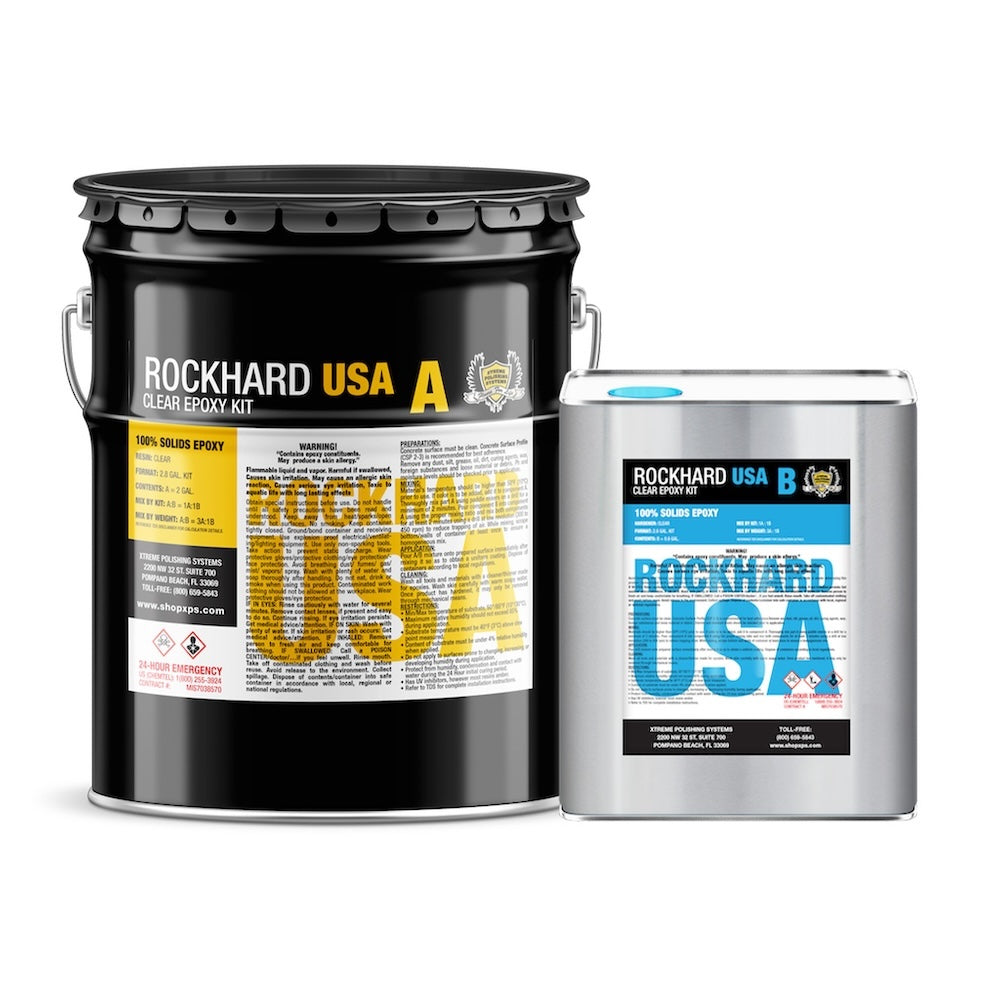
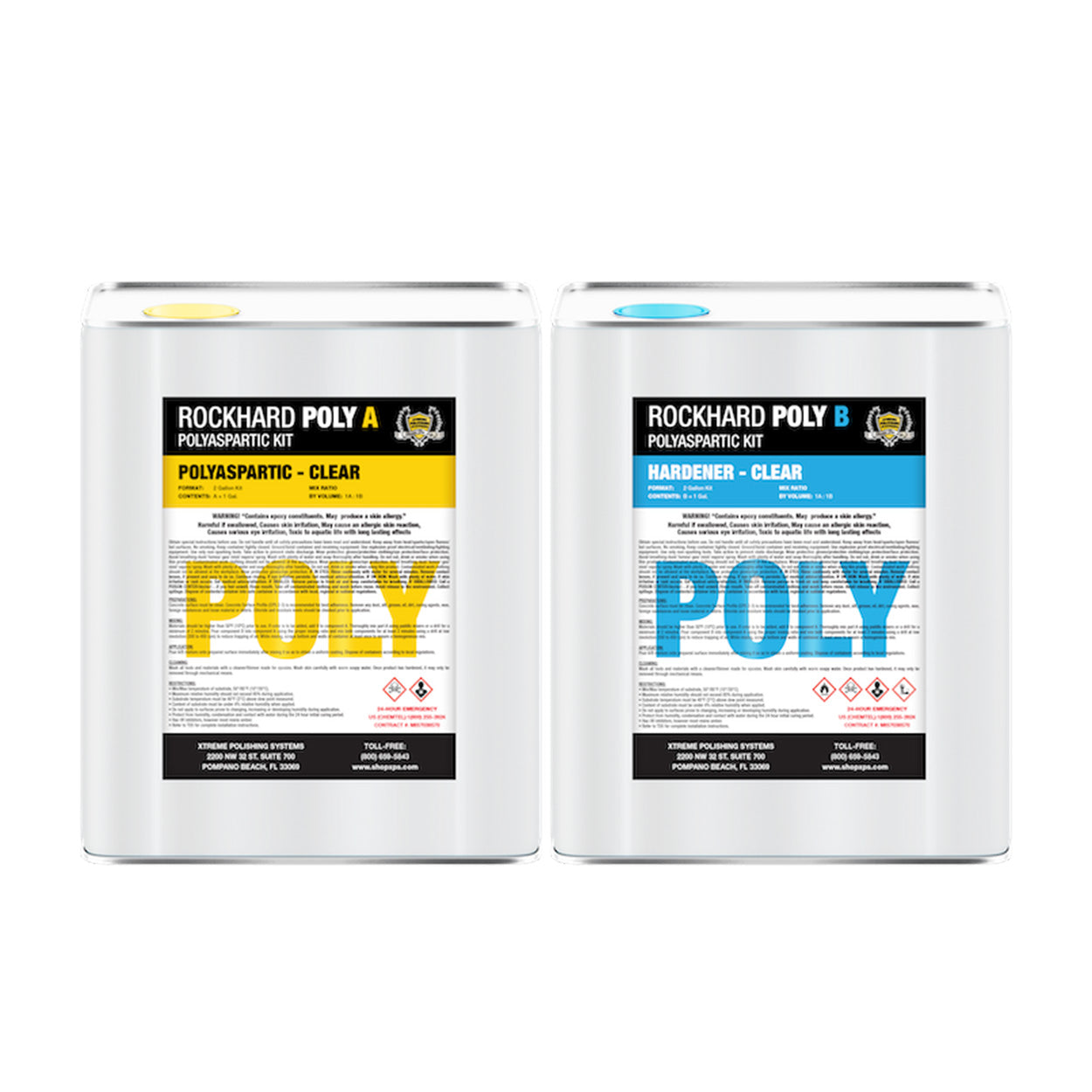
For instance, the Rockhard USA Epoxy Kit carries documented coverage rates of 450 sq. ft. per kit when applied as a flake floor base coat, 300 sq. ft. per kit for a two-coat solid color floor, and 300–600 sq. ft. per kit when utilized as a clear topcoat. Any good resin kit you purchase should include its coverage rates clearly and obviously.
By entering documented figures into your epoxy floor coverage rate calculator and applying CSP and porosity adjustments, you ensure target millage translates accurately to real-world performance.

2. Reduce Material Waste on Epoxy Flooring: Coverage Rate & Techniques
The moment you combine Part A and Part B, the chemical reaction begins, and the working clock starts ticking. "Hot potting" - leaving mixed epoxy sitting idle in a bulk bucket - remains one of the single largest sources of liquid material loss across the industry. Operational errors are product and time wasters, and they can lead to long-term failure if partially cured material spreads onto the slab.
To maintain maximum control over your working times, structure your batch mixing around your crew's exact placement speed:
-
Size Batches to Crew Capacity: Mix only the amount of material your crew can comfortably spread and back-roll within approximately 50% of the manufacturer's stated pot life. Account for crew size, application speed, floor layout, and the time needed to complete each section.
- Smaller batches help reduce the risk of material setting up before application is complete.
- Smaller batches help reduce the risk of material setting up before application is complete.
-
Adjust for Slab, Ambient, and Material Temperatures: Epoxy pot life and working time decrease as temperatures increase. Many epoxy systems experience a significant reduction in pot life with every 18°F increase in temperature, although the exact relationship varies by product. Always refer to the manufacturer's technical data sheet for temperature-specific guidance.
- In warmer environments, use smaller batches, keep unmixed materials stored within the manufacturer's recommended temperature range, and consider a compatible slow-cure hardener when available.
- Monitor slab temperature, as it can affect application behavior and curing conditions.
- Ribbon Material Immediately: Never allow mixed epoxy to sit in the bucket while technicians complete edge work. Pour mixed resin out in long ribbons across the concrete immediately after mixing to dissipate exothermic heat and maximize usable working time.
It’s better to be a little too late on the mix rather than too early - if your resinous coating becomes unusable before you even start pouring, that’s your investment down the drain.
Selecting coating systems with versatile curing profiles further streamlines waste management. XPS POLYUREA is a two-component, 100% solids polyurethane basecoat available in Slow, Medium, Fast, and Super Fast Cure (Winter Version) formulations, offering an extended pot life of 35–45 minutes.
Frequently Asked Questions
How do I accurately calculate how much epoxy material I need for a project?
Measure the net square footage of the floor (excluding drains, pads, and structural columns) and divide by the manufacturer's recommended coverage rate. You'll want to adjust for concrete surface profile (CSP) and slab porosity, adding a controlled 5% to 10% waste factor for mixing container retention.
What is the typical concrete densifier coverage rate per square foot?
Standard concrete densifier coverage ranges between 300 and 500 sq. ft. per gallon. Exact coverage depends on substrate porosity and the diamond grit stage at which the chemical densifier is applied.
Why does mixed epoxy cure too rapidly in the mixing bucket?
High ambient or slab temperatures accelerate exothermic chemical reactions, cutting product pot life in half for every 15°F temperature increase. Pouring mixed epoxy immediately onto the slab in long ribbons dissipates heat and extends working time.
How does concrete surface profile (CSP) impact epoxy resin coverage rate?
Higher CSP profiles created by aggressive shot blasting or scarification contain deeper surface valleys. A CSP 4–5 profile can increase primer and base coat material consumption by 15% to 30% compared to a standard CSP 2 profile.
Can training programs help my crew reduce material waste?
Yes, formal training establishes standardized mixing and application discipline. The EpoxyClasses 5-Day Hands-On Epoxy Certification Course provides comprehensive instruction covering surface preparation, moisture testing, coating installation, decorative flake systems, metallic epoxy, quartz, and polyaspartic topcoats. The course is designed for contracting crews who need repeatable field application discipline. Benefits include formal certification upon completion, small class sizes, and access to multiple training locations nationwide.
Conclusion
In a competitive industry like epoxy resin flooring, profits are often found on the margins. Every focus on the details of the process, and the details of your resource usage, helps save cost and builds profit down the line. Epoxy resin coverage rates are one of those key details you need to know to help save you money and deliver better results! XPS is here to help you use only what you need, when you need it.
Xtreme Polishing Systems (XPS) is your central hub for all things epoxy & concrete flooring! Whether you need guidance on a project or a refresh of your kit, call our technicians at (877) 958-5264! Check out our online store for the best resources on the market.